
SSPC VIS 1: the visual standard that settles blast cleaning disputes.
The blast standards define cleanliness in words and percentages. SSPC VIS 1 defines it in photographs — and on a real job site the photographs are what ends the argument between the blaster, the inspector and the owner's rep.
This page covers what VIS 1 contains, how it is used to accept work, and the four sibling guides (VIS 2 through VIS 5) that do the same job for other prep methods.
What SSPC VIS 1 is.
SSPC VIS 1 is a book of standardized color photographs showing what each abrasive blast grade looks like on steel that started in each initial rust condition.
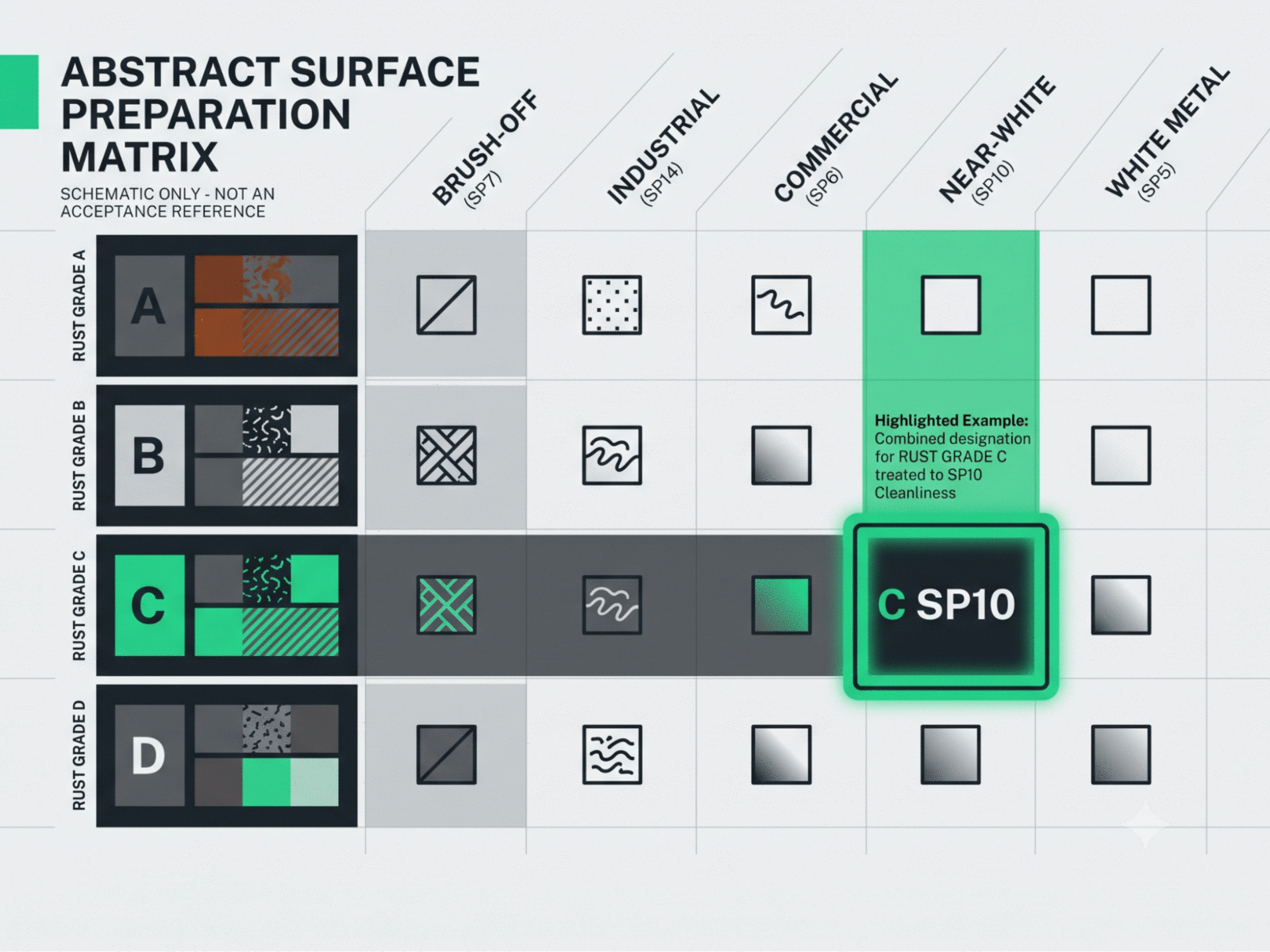
That second variable is the part newcomers miss. Blasted steel looks different depending on what it looked like before blasting, so VIS 1 organizes its photographs along two axes:
- Initial condition (rust grades A–D): A is intact mill scale, B is mill scale with rust beginning, C is rust with the mill scale gone, D is rust with visible pitting.
- Blast grade achieved: the SP grades covered on our abrasive blast cleaning page — brush-off through white metal.
A photograph designation combines the two, so “C SP10” shows near-white blast achieved on previously rusted steel. The written standard always governs (VIS 1 is a guide, and it says so itself), but in the field the photographs are the shared reference everyone judges against.
How VIS 1 is actually used in the field.
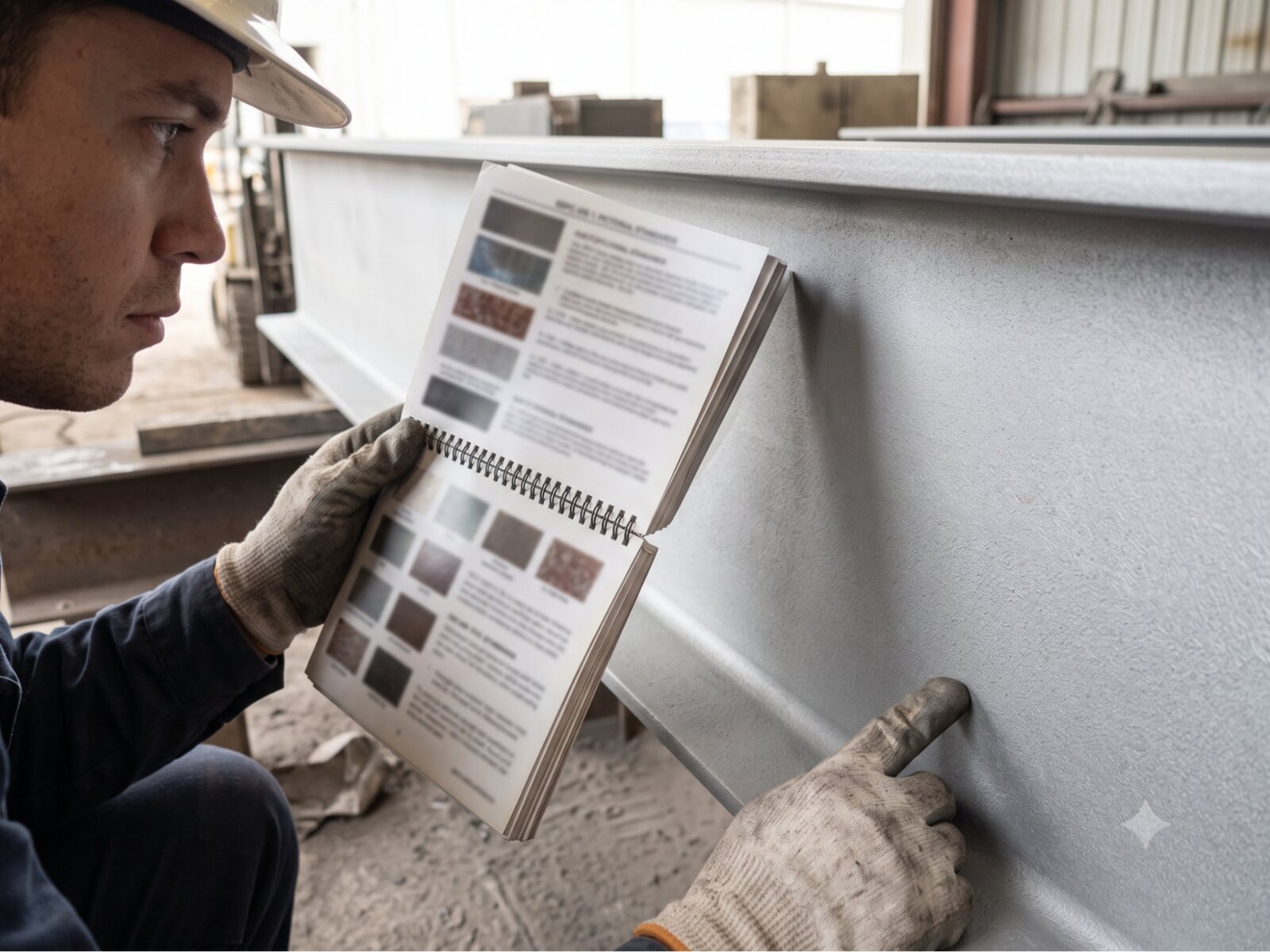
The ritual is simple and worth formalizing in your quality procedures. Before production blasting starts, the contractor and inspector agree on the initial rust condition of the steel and pull the corresponding photographs for the specified grade. As work proceeds, prepared surfaces are compared to the agreed photographs in adequate, consistent lighting — direct sunlight versus shop light changes how staining reads, which is a real source of disputes.
Some projects go a step further and blast a small test panel or reference area, accepted by all parties against VIS 1, that lives on site as the job's local standard. On contested work, that practice pays for itself the first time someone questions a borderline patch at 4 p.m. on a Friday.
That your inspection records name the VIS guide and the photograph designations used for acceptance, that your crews can demonstrate the comparison, and that your copy of VIS 1 is a current edition rather than a sun-bleached photocopy — which defeats the entire point of a color photographic standard.
Can you download SSPC VIS 1 as a PDF?
Not legitimately, and a pirated PDF would not serve you anyway. VIS 1 is a copyrighted publication sold by AMPP, and because it is a photographic standard, color fidelity matters; AMPP sells it in formats produced under color control. A screen-rendered or office-printed PDF shifts the colors you are supposed to be matching. Buy it from the AMPP store and treat it like the calibrated instrument it is.
The 1989 edition (“VIS 1-89”)
Searches for “SSPC VIS 1 89” usually trace to old specs citing the 1989 edition. VIS 1 has been revised since. If a legacy spec cites VIS 1-89, confirm with the specifier whether the current edition is acceptable; in practice it almost always is, but get it in writing.
The rest of the VIS family.
| Guide | Pairs with | What the photographs show |
|---|---|---|
| SSPC VIS 1 | Abrasive blast grades (SP5, SP6, SP7, SP10, SP14) | Dry blast-cleaned steel by initial condition and grade |
| SSPC VIS 2 | Coating condition evaluation | Degrees of rusting on previously painted surfaces |
| SSPC VIS 3 | Hand & power tool grades (SP2, SP3, SP11, SP15) | Tool-cleaned steel by initial condition and grade |
| SSPC VIS 4 | Waterjetting grades (WJ-1 to WJ-4) | Waterjetted steel, including flash-rust conditions |
| SSPC VIS 5 | Wet abrasive blast | Wet-blasted steel, including flash-rust conditions |
SSPC VIS 2: Evaluating Degree of Rusting on Painted Steel
VIS 2 is the odd member: it evaluates coatings in service, not prepared steel. Its photographs grade how much rust is breaking through an existing paint system on a numeric scale, which drives maintenance decisions: spot repair, zone repair, or full recoat. If you write condition surveys, VIS 2 is the vocabulary your report should use.
SSPC VIS 3: Hand & Power Tool Cleaned Steel
VIS 3 does for SP2, SP3, SP11 and SP15 what VIS 1 does for blast: reference photographs by initial condition and achieved grade. Because tool-cleaned surfaces vary more with technique than blasted ones, the photographic reference is arguably even more valuable here.
SSPC VIS 4: Waterjetted Steel
Pairs with the WJ-1 through WJ-4 waterjetting standards. Its distinctive feature is flash-rust photographs: waterjetted steel re-rusts quickly, and VIS 4 shows the light, moderate and heavy flash-rust conditions the WJ standards reference.
SSPC VIS 5: Wet Abrasive Blast Cleaned Steel
The same concept for wet abrasive blast, which combines blast profile with water and therefore also needs flash-rust references. If your spec involves vapor abrasive equipment, VIS 5 is the matching guide.
Where VIS records fit in a QP audit.
Visual acceptance is the weakest link in most coatings quality systems we review, precisely because it feels informal. The fix is cheap: a current VIS guide on site, photograph designations recorded at each acceptance, and a procedure that says who compares, in what light, against which edition. QP1 and QP3 auditors sample inspection records for exactly this traceability.
Building that procedure (and the rest of the system around it) is the work we do for contractors pursuing certification. Start at AMPP/SSPC QP certification consulting.
Thirty minutes, no obligation, with someone who has sat on both sides of the audit table.
Contact us to get startedVIS guides, answered.
Is SSPC VIS 1 mandatory on blast projects?
It is only mandatory if the project specification explicitly invokes it, which is the case for most industrial contracts. However, even when it is not contractually required, utilizing VIS 1 is standard industry practice. It provides the only practical visual benchmark for inspectors and contractors to look at the same piece of steel and agree on whether it meets the SP6 or SP10 cleanliness standard.
Which governs if the photographs and the written standard disagree?
The written standard always governs. VIS 1 explicitly states that it is an advisory guide designed to supplement the written SP standards, not replace them. While the photographs are incredibly valuable for calibrating visual judgment on the shop floor, the written text defines the actual contractual requirement.
Is VIS 1 the same as the ISO 8501-1 photographs?
No. ISO 8501-1 contains its own photographic references organized around the Sa and St grades and rust grades A through D. The concepts parallel each other (see our SSPC vs ISO comparison), but the books, grades and photographs are distinct. A job specified to SSPC grades should be judged against VIS guides, not ISO plates.
Which VIS guide applies to power tool cleaning?
SSPC VIS 3 is the correct visual guide for hand and power tool cleaning, whereas VIS 1 applies strictly to dry abrasive blasting. Attempting to use VIS 1 photographs to evaluate or accept SP3 or SP11 tool-cleaned surfaces is a fundamental error that any qualified quality auditor will immediately notice and flag.
About Freer Consulting

We are a small firm by design. No layers of salespeople, no junior staff learning on your invoice. The consultants who scope your project are the practitioners who deliver it, working on-site or remotely through the Global Virtual Playbook we pioneered for clients across the US and internationally.
We establish long-term, productive relationships with our clients. Our experience means we get it right the first time — and our standards ensure your company realizes the benefits of getting it right, again and again.
The same engineering bench that prepares your AMPP/SSPC QP work also supports AISC, API Spec Q1, and ISO 9001 programs — so when your shop carries more than one certification, we keep them aligned on one quality system.
“I've worked with the Freer Team for over 6 years on our safety, quality, and environmental management system compliance and they've proven time and time again to provide consistent and comprehensive work on all fronts. They are always there when we need them.”
Visual acceptance the weak link in your quality system?
It is the cheapest finding to fix and the easiest to overlook. Thirty minutes with a consultant tells you where yours stands.