Freer Consulting

AISC certified erector: how erectors earn it.


Fabricator certification covers the shop. Erector certification covers everything that happens after the truck leaves: erection planning, field welding and bolting, and connection inspection. AISC audits erectors as their own program because the jobsite is its own world.

If your crew is working toward Certified Steel Erector (CSE) status, this page covers what the program is, what the audit requires, and how erectors get there.

  • 27+ years of industrial compliance and certification consulting.
  • One call tells you how far your operation is from ready.
The program

The AISC erector certification program: one certification.

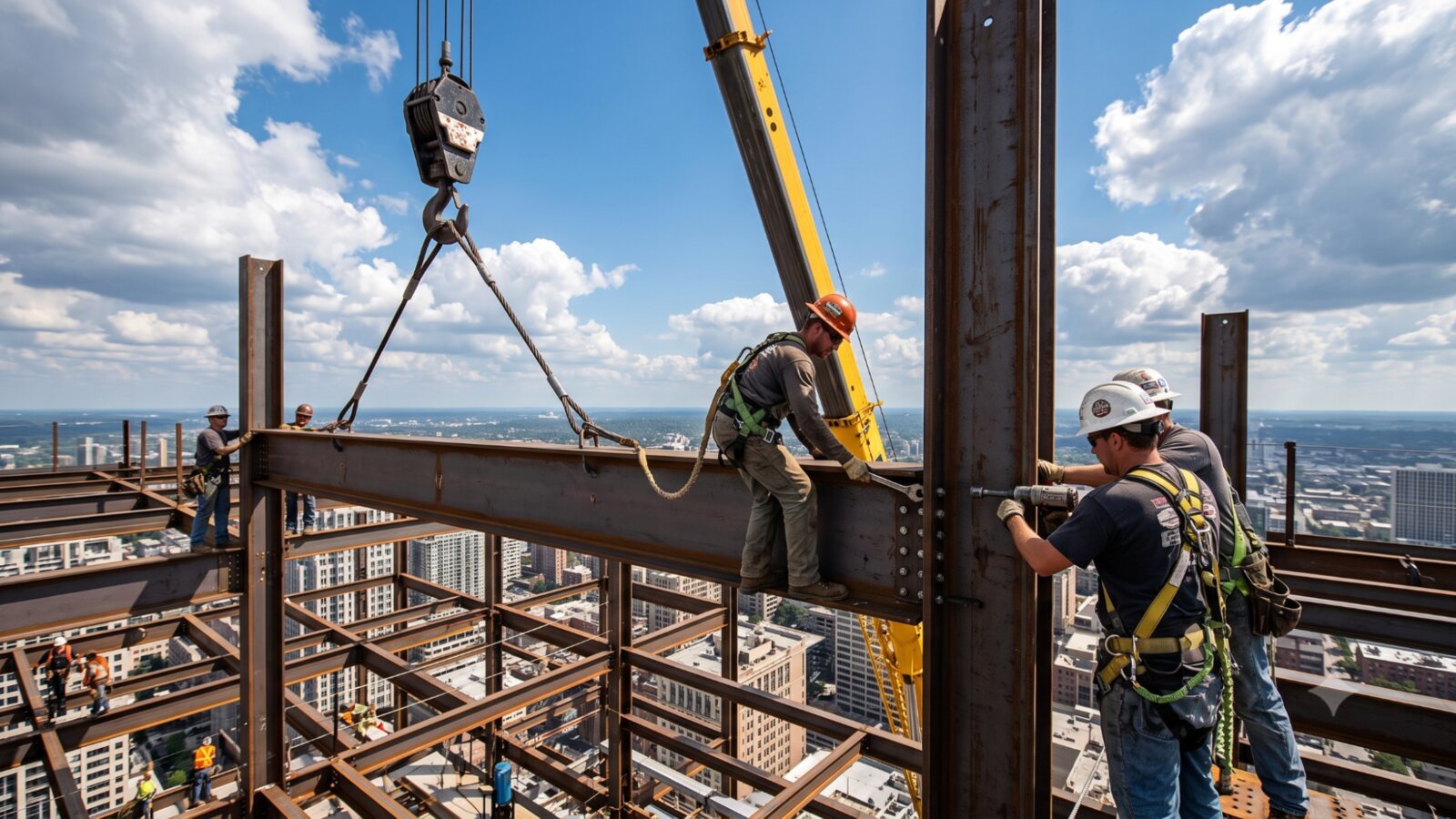
AISC certified erector crew connecting a structural steel beam at height with a crane

AISC certifies erectors under a single program.

Certified Steel Erector (CSE)

It verifies that your company runs a documented quality management system for steel erection, audited against AISC 207. Since 2013 this is the only erector certification AISC offers — every spec that calls for a certified erector resolves to it.

Optional endorsements

Certified erectors can add optional endorsements that demonstrate specialized field capabilities beyond the base certification. If a spec on your radar calls one out, the CSE certification comes first and the endorsement builds on it — which to pursue is one of the first things we sort out in a scoping call.

Still seeing "Advanced Certified Steel Erector" in spec language? That was a legacy tier AISC retired in 2013 when it consolidated erector certification into the single CSE program. Older or copied-forward specs still name it; in practice it resolves to current CSE certification. If a spec is ambiguous, that is worth a phone call before you price the pursuit.

Getting certified

How to become an AISC certified erector, and what it requires.

The audit verifies a working management system, not a paper one. For an erector, the disciplines under review are the jobsite's:

  1. Erection planning and sequencing. Documented pre-job planning: sequence, stability during erection, temporary bracing, and crane and rigging considerations, scaled to the complexity of your work.
  2. Field welding and bolting. Qualified welding procedures and welders for field conditions, and a bolting program that controls installation and pretensioning methods. Field quality is harder to control than shop quality, and auditors treat it that way.
  3. Inspection of field connections. Defined inspection responsibilities and records for bolted and welded connections, with a nonconformance process for what inspection finds.
  4. Crew qualifications and document control. Training and qualification records for the people doing the work, and current drawings and erection plans in the field — not in the trailer under last month's paperwork.

One thing the audit no longer reviews: safety. AISC removed safety requirements from erector certification effective January 1, 2025 — your OSHA and project-level safety obligations are unchanged, but the AISC auditor does not review your safety program. See what the 2025 change means for your certification.

The shape of the path is the same as any AISC program: gap assessment, system build-out, run the system long enough to generate records, then the audit. The clause-level detail of the standard lives on our AISC certification requirements page, and what the effort costs is on the cost page.

The honest difficulty for erectors is that your "shop floor" reassembles itself on every project. Building a system that holds up across changing sites, GCs, and crews is exactly the kind of problem that benefits from someone who has watched it fail and succeed at other contractors. That is the work we do.

Erector certification is one program within our AISC certification consulting practice. If you would rather talk through your situation than read about it:

Contact us to get started
Field, not shop

Erector certification vs fabricator certification.

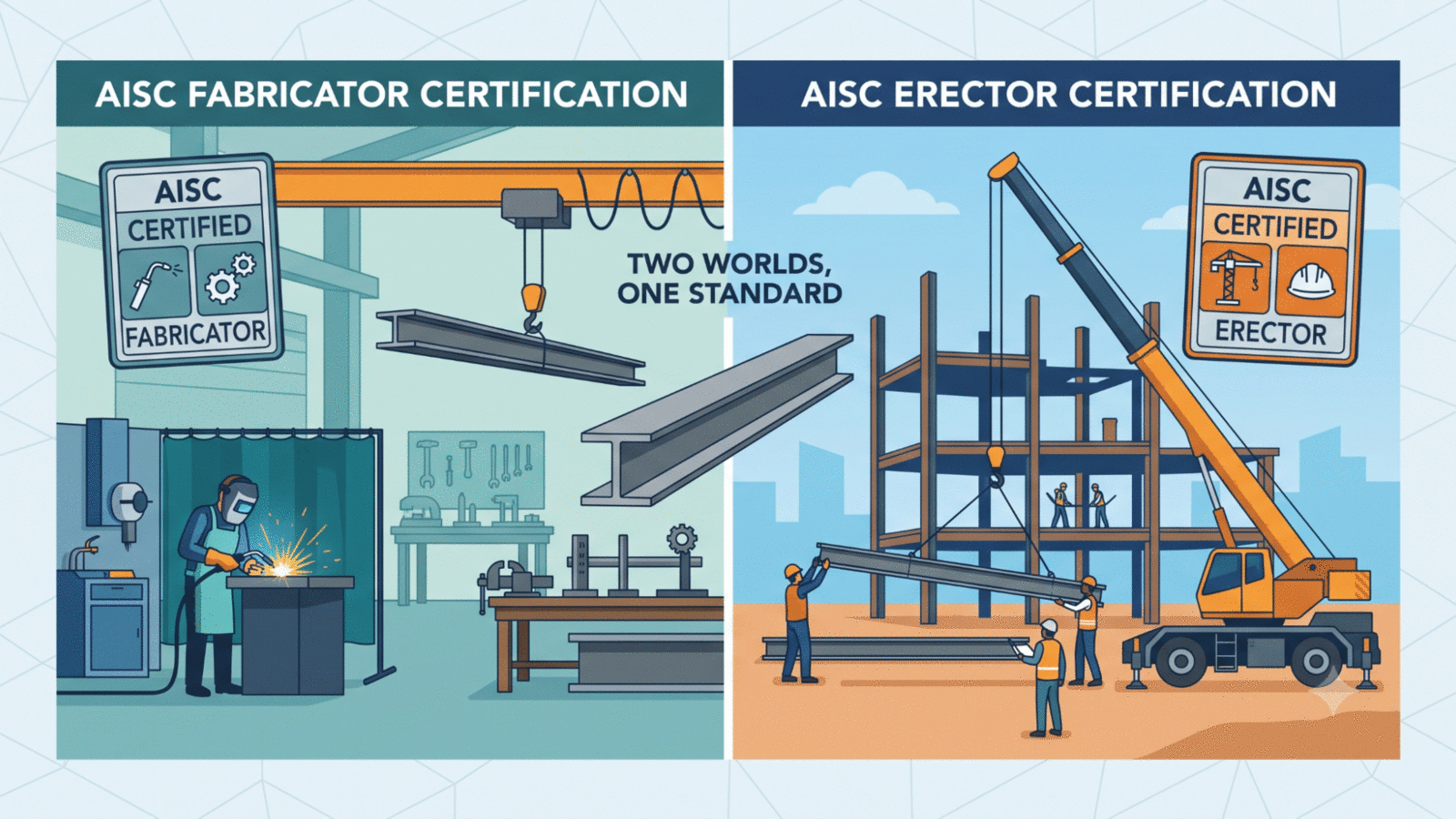
AISC certified fabricator work in the shop beside AISC certified erector work on the jobsite — two worlds, one standard

The two programs share a standard, AISC 207, but audit different worlds. The fabricator audit walks a shop: receiving, material control, welding stations, inspection benches. The erector audit follows the work to the jobsite: planning, field connections, and crew competence under conditions no shop has to deal with.

Companies that both fabricate and erect typically hold both certifications. The trap is running them as two separate paper systems that drift apart and double the maintenance. Built right, one quality system carries both audits, and that alignment is something we design in from the start rather than reconcile later. If your shop side is the open question, see how fabricators earn AISC certification.

Checking whether an erector is certified? AISC's listing of certified companies on aisc.org is the authoritative source. If the goal is getting your own crew on that list, keep reading:

FAQ

Erector certification, answered.

How do I become an AISC certified erector?

Build and run a quality management system that meets AISC 207, generate the records that prove it, and pass the third-party audit. The four disciplines above are where the audit looks. How long that takes depends on what you already have documented; a scoping call gives you a real answer for your operation.

What about Advanced Certified Steel Erector (ASE)?

ASE was a legacy advanced tier that AISC retired in 2013; today there is a single Certified Steel Erector program. If a spec you are bidding still names "advanced certified steel erector," it is almost certainly copied-forward language that current CSE certification satisfies — but confirm with the engineer of record before you price the pursuit. We help erectors make that call.

Do erectors still need to submit a safety plan?

No. AISC removed safety requirements from erector certification entirely, effective January 1, 2025 — safety plans are no longer submitted, and the audit does not review your safety program. Your OSHA and project-specific safety obligations are unchanged. Read what the 2025 change means for your certification for the details.

We fabricate and erect. Do we need both certifications?

If the specs you bid call for certified fabrication and certified erection, yes — they are separate programs. The good news is one well-built quality system can carry both audits, which is cheaper to build and far cheaper to maintain than two parallel systems. That alignment is one of the first things we look at in a scoping call.

What does erector certification cost?

It comes down to the same three layers as any AISC program the direct AISC fees, your internal team's time, and any outside consulting help you bring in. The final number is scaled by the gap between your current processes and the standard. You can find a full breakdown on our AISC certification cost page.

About Freer Consulting


The Freer Consulting team meeting around a conference table

Freer Consulting Co. has 27+ years of experience in a wide range of business consulting fields. Our well-rounded, experienced team has a proven record of meeting business needs and achieving results on-time and within budget. We work with businesses across the United States and internationally, providing both on-site and remote consultation. In our industry, Freer pioneered the Global Virtual Playbook, which allows us to provide expert remote consultation to our clients across the globe.

We establish long-term, productive relationships with our clients. We can grow with your company and provide services as you need them. Our experience means we get it right for your company the first time. Our standards ensure your company realizes the benefits of getting it right, again and again.

The same engineering bench that guides your AISC certification also supports ISO 9001, API Q1, and AMPP/SSPC programs — so when your crew carries more than one certification, we keep them aligned instead of running disconnected systems.

“I've worked with the Freer Team for over 6 years on our safety, quality, and environmental management system compliance and they've proven time and time again to provide consistent and comprehensive work on all fronts. They are always there when we need them.”
Megan · Hawaii
Get certified to erect

Working toward certified erector status?

A free 30-minute call and we'll map the path from your current field operations to a passed erector audit.