The rapid expansion of artificial intelligence infrastructure and data center construction is driving a historic shift in industrial power requirements. To meet this demand, utilities are increasingly turning to nuclear energy expansion, including traditional generation upgrades and small modular reactors (SMRs).
For manufacturers of precast concrete, underground utility vaults, and structural components, this market expansion represents a significant commercial opportunity. However, entering the nuclear supply chain requires a clear understanding of specialized quality management systems.
When structural and utility manufacturers begin evaluating this sector, they often encounter ISO 19443. Determining whether this specific designation is required, or if alternative compliance paths are more practical, is the first critical step toward qualification.
The Nuclear Quality Landscape: ISO 19443 vs. US Regulations
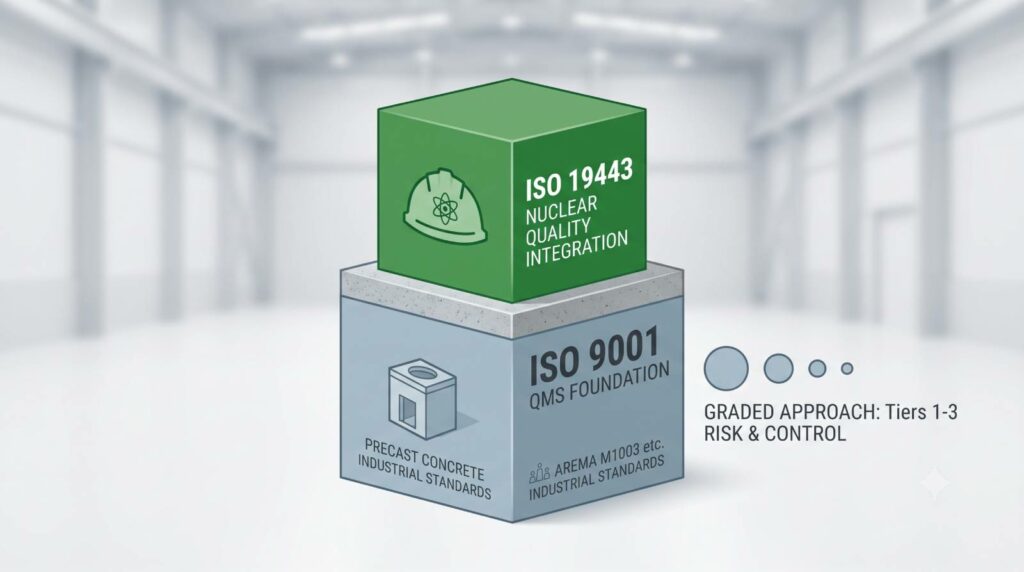
ISO 19443 is an international quality management standard tailored specifically for the nuclear energy sector. It builds directly upon the foundation of ISO 9001, adding strict protocols designed to ensure the integrity of products and services important to nuclear safety (ITNS).
The standard introduces several distinct requirements beyond standard industrial quality management:
- Nuclear Safety Culture: An organizational commitment where safety issues receive the attention warranted by their significance.
- Counterfeit, Fraudulent, and Suspect Items (CFSI): Rigorous detection and prevention protocols to keep unverified materials out of the production stream.
- The Graded Approach: Applying quality controls proportionally based on the safety significance of the specific component.
While ISO 19443 is gaining widespread adoption across European civil nuclear projects and international supply chains, the regulatory framework in the United States relies primarily on domestic standards. Manufacturers targeting US utility projects will more frequently encounter 10 CFR Part 50 Appendix B, 10 CFR Part 21, and ASME NQA-1 (Quality Assurance Requirements for Nuclear Facility Applications).
Understanding the distinction between international ITNS designations and domestic safety-related classifications determines your exact compliance roadmap.
Do Precast and Utility Manufacturers Explicitly Need ISO 19443?
There is no universal rule stating that a precast concrete or underground utility manufacturer must hold an ISO 19443 certification to sell to the nuclear industry. The necessity of any nuclear quality designation depends entirely on two factors: the safety classification of your specific product and the procurement specifications issued by the buyer.
Nuclear components generally fall into three procurement categories.
| Procurement Category | Application Example | Common Quality Framework | Certification Requirement |
|---|---|---|---|
| Safety-Related | Containment structures, critical safety vaulting | ASME NQA-1 / 10 CFR 50 App B | Full program implementation or formal audit |
| Important to Nuclear Safety (ITNS) | Specialized international infrastructure, cooling channel routing | ISO 19443 | Common in European markets; selective in the US |
| Balance of Plant / Commercial | Standard security enclosures, non-critical utility trenches | Standard QMS (ISO 9001) + Project Specs | Commercial quality with enhanced traceability |
For many underground utility enclosures, manufacturers can utilize an alternative pathway known as Commercial Grade Dedication (CGD). Under a CGD program, a commercial-grade product is manufactured under standard industrial quality controls and then subjected to rigorous testing, inspection, or critical characteristic verification by a dedicating entity (often the utility or a tier-1 contractor) before it is accepted for safety-related use. This path allows manufacturers to supply critical components without immediately establishing a full, standalone nuclear quality program.
For structural steel applications, different requirements apply, which you can review in our analysis of why AISC N690 certification matters.
Mapping Existing Quality Systems to Nuclear Expectations
If your manufacturing facility already operates under a highly disciplined quality framework, you are not starting from scratch. For example, suppliers holding an AREMA M1003 certification (the stringent quality assurance standard required to sell to Class 1 railroads) already execute rigorous material traceability, document control, and corrective action programs.
When transitioning from a mature framework like AREMA M1003 to a nuclear quality system, the primary gaps you must bridge include:
- Regulatory Reporting Obligations: Implementing procedures to comply with 10 CFR Part 21, which mandates the immediate reporting of safety defects directly to the Nuclear Regulatory Commission (NRC).
- Enhanced Material Traceability: Extending material certifications down to the foundational chemical and physical properties of every aggregate, rebar heat, or embedded component.
- Formal Graded QA Processes: Documenting exactly how your team adjusts inspection frequencies and material testing based on the safety tier of the specific project item.
Note on Material Validation: In the nuclear sector, standard commercial material certifications are rarely accepted at face value. Auditable proof of origin and independent verification are standard requirements.
Evaluating Time and Cost Commitments
Because nuclear qualification is highly dependent on your current quality system maturity and target product lines, fixed costs and timelines do not exist. Instead, the total investment is driven by specific operational variables.
- The Scope of Gaps: If your facility already maintains a system like ISO 9001 or AREMA M1003, the timeline to align with nuclear expectations is significantly compressed compared to a shop operating without a formalized quality management system.
- Personnel Training: Developing a true nuclear safety culture requires dedicated training hours for engineering, quality assurance, and production floor personnel.
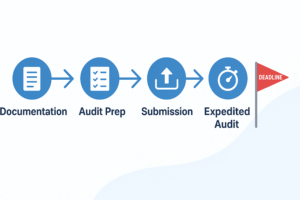
- Audit and Assessment Costs: Pursuing formal certification or preparing for a multi-day nuclear utility audit involves extensive documentation prep and third-party evaluation fees [VERIFY: typical standard audit preparation hour ranges or industry averages for nuclear assessments].
Rather than chasing an expensive certification upfront based on guesswork, the most practical approach is to conduct an initial scoping assessment to determine the exact requirements of your target buyers.
Determining Your Next Step
The decision to enter the nuclear supply chain should be driven by commercial reality, not regulatory panic. Before rewriting your quality manuals or committing capital to a new certification program, you need an objective analysis of your existing capabilities against the specific demands of upcoming energy projects.
Freer Consulting provides structured clarity at this discovery stage. Our nuclear power quality assurance consulting focuses on matching your operational reality with realistic market access.
Instead of generic compliance templates, we deliver a specialized Integrated Nuclear Quality Management System Assessment. This service evaluates your current production processes, maps your existing certifications to nuclear expectations, and establishes a practical roadmap detailing the exact time and investment required to qualify for your target contracts.
To discuss whether nuclear supply chain qualification aligns with your facility’s long-term commercial goals, contact Freer Consulting at (206) 679-2357 to schedule an initial scoping conversation.